
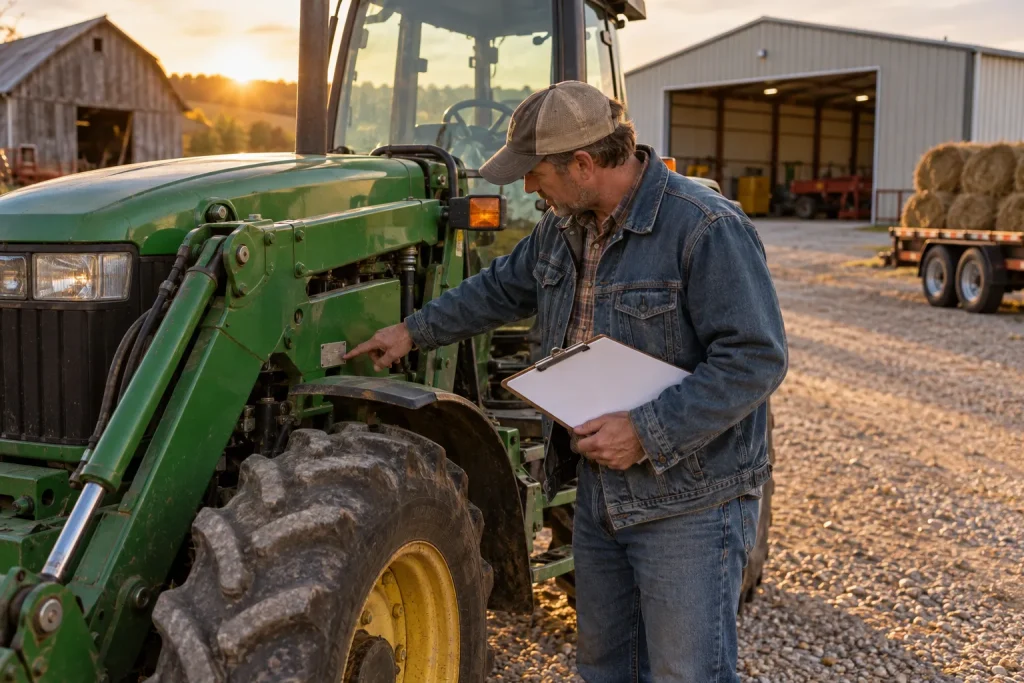
farm depreciation
Farm depreciation depends on what each asset does, how it is used, and which tax rules apply. A fence, water well, livestock structure, general-purpose barn, and tractor may have different recovery periods, even when they are part of the same ranch. Classifying assets by function helps owners understand which costs may be depreciated and what records support the treatment.
Key Takeaways
- Recovery periods on a ranch vary widely, and agricultural fences, qualifying single-purpose livestock structures, water wells, and general-purpose farm buildings each follow their own classification rules under IRS guidance.
- Classification depends on the actual function, design, and use of each asset rather than on the fact that the property sits on a farm or ranch.
- Earthen stock tanks, ponds, terraces, and similar land-shaping costs may be nondepreciable when they lack a determinable useful life, and qualifying conservation expenditures may instead warrant evaluation under Section 175.
- For qualified property acquired after January 19, 2025, current law generally allows 100% bonus depreciation under Section 168(k), but every asset must independently meet the statutory requirements.
- Depreciation schedules should be reviewed annually and whenever significant assets are acquired, built, sold, converted to personal use, leased, or changed in use.
The practical starting point is an asset-by-asset review, not a single recovery period for the entire property. IRS Publication 225 and Publication 946 provide references for farm property, but the facts and applicable rules determine the treatment of a particular asset.
Farm Depreciation Basics: Direct Answer, Schedule F Reporting, and Why Classification Matters
What farm depreciation means in plain terms
Depreciation generally allocates the cost of eligible business property over a tax recovery period. For farm equipment, the correct period depends on the equipment’s classification and use; a tractor or combine should not be assigned a life based on its name alone. Land is not depreciable, and property used personally may not qualify for business depreciation. A farm depreciation review starts by identifying each asset, its business use, cost or basis, and placed-in-service date.
Key takeaways: function drives recovery periods
Reporting depreciation on Schedule F and Form 4562
Farmers generally report business income and expenses on Schedule F, while Form 4562 is used to report depreciation and certain elections. The correct reporting depends on the taxpayer’s activity, asset use, and filing circumstances. Keep purchase records, construction invoices, placed-in-service dates, and documentation of business use with the depreciation schedule. Those records help connect each reported deduction to a specific asset and support later reviews when property is sold or its use changes.
MACRS vs. ADS: choosing a depreciation system
The General Depreciation System (GDS) and Alternative Depreciation System (ADS) can assign different recovery periods to property. GDS is the general system, while ADS applies in specified circumstances and may also be required or elected under particular rules. The table below illustrates why identifying the system matters: agricultural fences are listed at 7 years under GDS and 10 years under ADS, while depreciable farming or livestock wells are generally 15 years under GDS and 20 years under ADS, according to IRS Publication 225. Confirm the applicable system for the taxpayer and property.
| Depreciation system | How it is used | Ranch example |
|---|---|---|
| GDS | General system for assigning recovery periods under applicable depreciation rules. | Agricultural fences: 7 years; depreciable farming or livestock wells: generally 15 years. |
| ADS | Alternative system that may apply under specific requirements or elections. | Agricultural fences: 10 years; depreciable farming or livestock wells: generally 20 years. |
Ranch Asset Classification Map: Fences, Wells, Livestock Structures, Barns, and Land Improvements

A ranch may include depreciable assets, land improvements, and costs that are not depreciable. Classification can depend on design, construction, actual use, and whether a component is separately identifiable. The periods below are general GDS references, not a substitute for examining the asset and the taxpayer’s circumstances.
Agricultural fences as 7-year property under IRS Publication 225
IRS Publication 225 lists agricultural fences as 7-year GDS property and 10-year ADS property, rather than treating all fencing as a 15-year land improvement. Review gates and separately identifiable components on their own facts. Invoices, maps, and descriptions of the fence’s use can help establish whether it serves the farming business and how its costs should be recorded.
Water wells, drainage, and ranch roads as 15-year property
Depreciable water wells used in farming or livestock operations are generally 15-year GDS property, or 20-year ADS property; drainage facilities are generally 15-year GDS property, based on IRS Publication 225. Pumps, piping, storage tanks, and electrical components may need separate classification. Roads, paved lots, and similar site improvements also require a review of their function and relationship to other assets.
Earthen stock tanks, ponds, terraces, and land shaping
Not every water-related ranch expenditure is depreciable. Earthen stock tanks, ponds, terraces, excavation, grading, and similar land-shaping costs may be nondepreciable when they lack a determinable useful life. In some circumstances, qualifying soil and water conservation expenditures may warrant evaluation under Section 175. Do not assume earthwork receives the same treatment as a well, pump, pipeline, or manufactured water-storage system.
Single-purpose livestock structures under Section 168(i)(13): the housing, raising, and feeding test
Section 168(i)(13) provides a specialized rule for qualifying single-purpose agricultural or horticultural structures, which are 10-year property. For a livestock structure, the statute requires an enclosure or structure specifically designed, constructed, and used exclusively for housing, raising, and feeding a particular type of livestock and its produce, and for housing equipment necessary for those functions. A general-purpose farm building, by contrast, is generally 20-year property. This conjunctive statutory wording requires preparer confirmation before publication; actual design and use must be reviewed.
General-purpose farm buildings as 20-year property
Barns, shops, and machine sheds used in farming may be general-purpose farm buildings, generally 20-year GDS property. A building does not become a qualifying single-purpose livestock structure merely because livestock are kept on the ranch. Mixed storage, repairs, equipment use, personal use, and residential portions can affect classification. Separate components or distinct uses may require additional analysis rather than assigning one treatment to the entire building.
MACRS recovery period reference table with factual review questions
This reference helps organize an initial asset review. Confirm each category against current primary authority and the property’s records before applying a recovery period.
| Asset or category | General reference (GDS recovery period) | Key factual question |
|---|---|---|
| Qualifying single-purpose livestock structure | 10-year | Is it specifically designed, constructed, and used exclusively for housing, raising, and feeding a particular type of livestock? |
| General-purpose farm building, such as a barn, shop, or machine shed | 20-year | Is it used in farming, and does any portion have residential, rental, personal, or nonfarm use? |
| Agricultural fences | 7-year | Is the fence used in farming, and are gates or other components separately identifiable? |
| Water wells used in farming or livestock operations | 15-year | Is the well depreciable, and can pumps, piping, tanks, or electrical components be identified separately? |
| Drainage facilities, roads, paved lots, and similar site improvements | 15-year | Does the component function as a distinct site improvement or as part of another asset? |
| Corrals, pens, chutes, cattle guards, pipelines, and manufactured tanks | Classification varies by asset and facts | What is the component’s function, construction, basis, and relationship to the overall system? |
| Earthen tanks, ponds, terraces, and land shaping | May be nondepreciable, or evaluated under Section 175 | Does the improvement have a determinable useful life? |
Reference periods reflect farm property recovery periods in IRS Publication 225. Alternative Depreciation System (ADS) periods are longer. Actual treatment depends on the asset’s facts.
Bonus Depreciation, Section 179, and Section 168(n): Current Rules and Ranch Asset Eligibility
Bonus depreciation, Section 179, and the qualified production property allowance under Section 168(n) are separate provisions with different eligibility tests. A ranch asset’s recovery period does not, by itself, establish eligibility for any of them. Review the asset’s acquisition and placed-in-service dates, business use, property type, and the taxpayer’s circumstances before treating a deduction as available.
100% bonus depreciation for property acquired after January 19, 2025 (Section 168(k))
Under current law, qualified property acquired after January 19, 2025, generally may qualify for a permanent 100% additional first-year depreciation deduction under Section 168(k), unless the taxpayer elects out for a class of property. IRS Notice 2026-11 provides interim guidance. Property acquired before January 20, 2025, remains subject to the phase-down rules applicable to its acquisition and placed-in-service year.
Each asset must independently satisfy Section 168(k), including acquisition, placed-in-service, business-use, and property-type requirements. A general-purpose farm building with a 20-year recovery period may qualify if it meets those requirements, but cost segregation does not create eligibility. IRS Publication 946 explains depreciation rules and should be checked alongside current authority and the property’s records.
Section 179 expensing: 2026 limits, taxable income tests, and which ranch assets qualify
For 2026, the Section 179 maximum deduction is $2,560,000, reduced when qualifying property placed in service exceeds $4,090,000 and fully phased out at $6,650,000, according to IRS Publication 946. The deduction is also subject to taxable-income and qualifying-property rules. Confirm the applicable limits and requirements for the tax year before making an election.
Not every ranch improvement qualifies. A qualifying single-purpose livestock structure is generally Section 1245 property and may be eligible for a Section 179 election. A general-purpose farm building generally is not eligible for Section 179 expensing as a building, even though it may qualify for bonus depreciation if it meets that provision’s separate requirements.
Section 168(n) qualified production property: a narrow rule for ranch operations
Section 168(n) provides a separate 100% special depreciation allowance for certain qualified production property (QPP), not general expensing for ranch improvements. QPP generally must be nonresidential real property used integrally in a qualified production activity involving manufacturing, production, or refining that substantially transforms property into a qualified product. Agricultural production is included in this framework. Construction generally must begin after January 19, 2025, and before January 1, 2029; the property generally must be placed in service after July 4, 2025, and before January 1, 2031. IRS Notice 2026-16 provides interim guidance.
For ordinary cattle operations, Section 168(n) may be inapplicable or offer limited incremental value. Many farm structures are 10-year or 20-year MACRS property rather than nonresidential real property. Grazing, livestock husbandry, mixed-use barns, residences, and routine working facilities should not be presumed to qualify. If QPP stops being used in a qualified production activity within 10 years, the allowance is generally subject to ordinary-income recapture. Because the nonresidential-real-property distinction and other requirements need technical confirmation, obtain property-specific advice before relying on this provision.
Comparison table: Section 168(k) vs. Section 179 vs. Section 168(n)
The provisions below are not interchangeable. The comparison can help identify which questions to take into an asset review; it does not determine whether a particular ranch asset qualifies or when an owner can use a deduction.
| Provision | What it may do | Key review point |
|---|---|---|
| Section 179 | Allow an elected deduction for qualifying property, subject to annual limits and taxable-income rules. | Check the tax-year limits, phase-down, eligibility, and distinction between single-purpose livestock structures and general-purpose buildings. |
| Section 168(n) | Allow a special depreciation allowance for qualifying production property. | Review substantial transformation, real property status, and construction and placed-in-service dates. |
Who Can Actually Use the Deductions: Basis Allocation, Material Participation, and Recapture
Identifying depreciable assets is only one part of the analysis. The owner must also establish the business-use basis, meet applicable participation and deduction rules, and consider what may happen when an asset is sold or changes use. A shorter recovery period does not, by itself, mean the owner can use the full deduction in the current year.
Hypothetical purchase-price allocation example with stated assumptions
Illustrative example only: A buyer acquires a working cattle ranch for $2,500,000. Assume a supportable allocation assigns $1,700,000 to land, $250,000 to the owner’s residence, $150,000 to a general-purpose barn, and $400,000 to fences, a livestock water well, handling facilities, and a single-purpose livestock structure. Land is not depreciable, and the residence is generally not depreciable unless used in the business or rented. The analysis would focus on the $550,000 of business-improvement basis, its proper classification, and whether the owner can currently use the resulting deductions. The amounts are hypothetical and do not represent typical allocation percentages. They are not a valuation method or tax conclusion.
Material participation and passive loss rules for working ranchers
Under Section 469, whether a ranch loss is currently usable can depend on the activity’s classification, the owner’s participation, and other facts. Keep records that substantiate services and approximate hours, such as calendars, time records, appointment books, work orders, and narrative summaries. Distinguish operational duties from investor oversight. Contemporaneous daily logs can help, but other reasonable records may also establish participation. Review the owner’s full tax situation before treating a deduction as currently available.
Why short-stay rental rules are not a complete eligibility test
Rental-activity exceptions include average customer-use tests of 7 days or less, or 30 days or less when significant personal services are provided. Falling outside the rental-activity definition does not automatically make an activity nonpassive. The owner must still assess material participation and the full Section 469 framework before treating losses as nonpassive.
Look-back cost segregation and Form 3115 Section 481(a) catch-up
If the taxpayer qualifies for an applicable automatic accounting-method change, a favorable Section 481(a) adjustment for depreciation allowable but not previously claimed is generally included in full in the year of change. That catch-up may be a principal benefit of a look-back analysis. Bonus depreciation follows the rules for the year the property was originally placed in service, not the current rate retroactively. Filing history, method-change procedures, basis support, and the owner’s ability to use the deduction all require review.
Depreciation recapture on disposition: Section 1245 vs. Section 1250
Disposition planning should model each asset rather than treat the ranch as one property. A qualifying single-purpose livestock structure is generally Section 1245 property, so gain may be ordinary income to the extent of depreciation claimed. Section 168(n) property has separate recapture rules if it stops being used in a qualified production activity. Allocate expected proceeds among land, buildings, equipment, and separately classified improvements, and review the applicable Section 1245 and Section 1250 rules before a sale.
Next Steps: Verification Sources, Review Cadence, and When to Request a Tax Savings Evaluation

Primary sources: IRS Publication 225, Publication 946, Notice 2026-11, and Notice 2026-16
Use IRS Publication 225 and Publication 946 to check farm-property classifications and depreciation rules. Review Notice 2026-11 for interim guidance on Section 168(k) and Notice 2026-16 for Section 168(n). The IRS Cost Segregation Audit Technique Guide, Publication 5653, is examiner guidance, not law, IRS approval, or a safe harbor.
Pre-publication verification and property-specific advice limitations
Confirm current rules, dates, thresholds, elections, and procedures against primary authority close to publication and before filing. A preparer must specifically confirm the Section 168(i)(13) “housing, raising, and feeding” wording and Section 168(n)’s nonresidential-real-property distinction before this material is published or promoted. Asset classification and deduction usability depend on the property, records, and taxpayer’s circumstances.
Next step for ranch owners
Review depreciation schedules annually and when significant assets are acquired, built, sold, converted to personal use, leased, or changed in use. Gather invoices, construction records, maps, placed-in-service dates, and business-use documentation for a property-specific review. To discuss whether an approach fits your facts, request a tax savings evaluation from Trucess Tax Advisory.
Request a Tax Savings Evaluation
Frequently Asked Questions
How does depreciation work on a farm?
Farm depreciation generally allocates the cost of eligible business property over a tax recovery period that depends on the asset’s classification and actual use. Land is not depreciable, and each asset, such as a fence, water well, or tractor, should be reviewed individually rather than assigned a single recovery period for the entire property.
How long do you depreciate farm equipment?
Farm equipment recovery periods depend on the equipment’s classification and use, not its name alone. IRS Publication 225 and Publication 946 provide reference periods for farm property, but the facts of each asset, including its business use and placed-in-service date, determine the correct treatment.
What is Schedule F and how does it relate to farm depreciation?
Schedule F is the tax form farmers generally use to report farm business income and expenses. Depreciation itself is reported on Form 4562, and records such as purchase invoices, construction costs, and placed-in-service dates should be kept with the depreciation schedule to support each reported deduction.
How do you calculate depreciation on ranch assets like fences and water wells?
Calculating ranch depreciation starts with an asset-by-asset review of each item’s cost basis, business use, and placed-in-service date. Under IRS Publication 225, agricultural fences are generally 7-year GDS property, while depreciable farming or livestock water wells are generally 15-year GDS property, with longer periods under ADS.
What is the difference between a single-purpose livestock structure and a general-purpose barn?
A single-purpose livestock structure is specifically designed, constructed, and used exclusively for housing, raising, and feeding a particular type of livestock, and may qualify as 10-year property under Section 168(i)(13). A general-purpose farm building used for mixed storage or other activities does not qualify on that basis and is generally 20-year property.
Can a cattle ranch qualify for bonus depreciation?
A cattle ranch may qualify for bonus depreciation on specific assets, but eligibility is never automatic.
Are ponds and earthen stock tanks depreciable farm assets?
Earthen stock tanks, ponds, terraces, excavation, and similar land-shaping costs may be nondepreciable when they lack a determinable useful life. In some circumstances, qualifying soil and water conservation expenditures may be evaluated under Section 175, and earthwork should not be classified the same as a well, pump, or manufactured water-storage system.